Versailles, where Picquart’s mother lived
An Officer and a SpyVersailles, where Picquart’s mother lived, joins Georges Picquart’s private obligations to the public drama of the Dreyfus affair. He travels there from the capital to spend time with his elderly mother, and the town also becomes the setting for a parliamentary vote that exposes the limits of Auguste Mercier’s political standing.
A Family Home Near the Station
On a winter evening, Picquart makes the journey to Versailles in civilian clothes, traveling through snow-darkened suburbs on a train that takes almost an hour. He is alone in the carriage and tries to read, but the lights repeatedly fail as the train crosses points. In the darkness, he imagines Alfred Dreyfus confined in La Santé Prison and anticipates the hardship of his likely transport west toward an Atlantic port and deportation. The journey thus brings the distant consequences of Dreyfus’s imprisonment into Picquart’s private passage to his family.
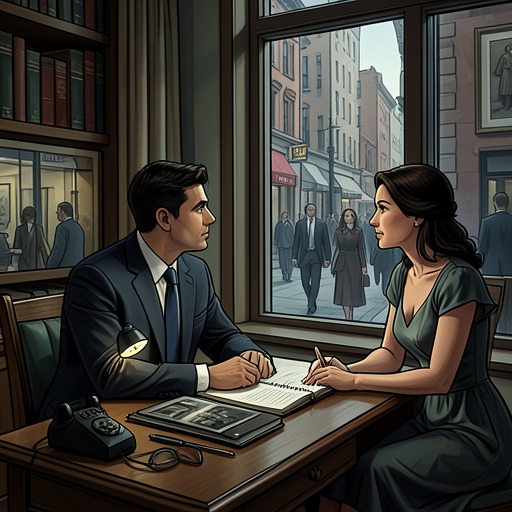
Picquart’s mother lives alone in a small apartment on a modern street near the railway station. At seventy-seven, she has been a widow for almost thirty years. Picquart and his older sister, Anna, take turns staying with her; his own visit usually falls on Saturday night, the one time he can reliably get away from his work. His arrival, well after dark in severe cold, begins with his mother calling through the locked door to ask who is there. The domestic routine is modest and recurring, set against the demands of his military life.
The Walk to Saint-Louis
The following morning, bells accompany Picquart as he takes his mother’s fragile arm and escorts her along an icy road to the cathedral of Saint-Louis. He waits outside while she attends Mass. Their brief exchange at the entrance makes the arrangement feel habitual: she asks whether he is coming in, and he explains that they have this conversation every week. Picquart’s care is expressed through the walk and the steadying arm, while his refusal to enter marks a clear difference between his mother’s religious practice and his own view of the cathedral as an emblem of state superstition.
The visit falls across the night of 5 January 1895 into 6 January. In his mother’s spare bedroom, Picquart’s thoughts turn not to Alfred Dreyfus’s protest of innocence but to Mercier’s hint that his own service may bring promotion. Versailles therefore holds two competing concerns in the same domestic interval: the fate of a prisoner Picquart imagines in transit, and the professional recognition he has reason to expect.
A Political Stage
Versailles has a second, explicitly public significance in the account. After President Jean Casimir-Perier resigns in January, the Senate and Chamber of Deputies assemble there to choose his successor. Mercier’s supporters circulate a flyer urging the election of the man who had delivered Dreyfus to court-martial, but Mercier receives precisely three votes out of eight hundred. The result punctures the political ambition behind the campaign and leaves him with the resentment of politicians who will not forgive him.
The contrast gives the town its particular narrative weight. In one strand, Versailles is the nearby refuge where Picquart fulfils a recurring family duty and confronts, in imagination, the human cost of Dreyfus’s fate. In another, it is the seat of a formal national decision, where Mercier’s association with the prosecution fails to translate into political support. The same place accommodates quiet care and public calculation without resolving the tension between them.